
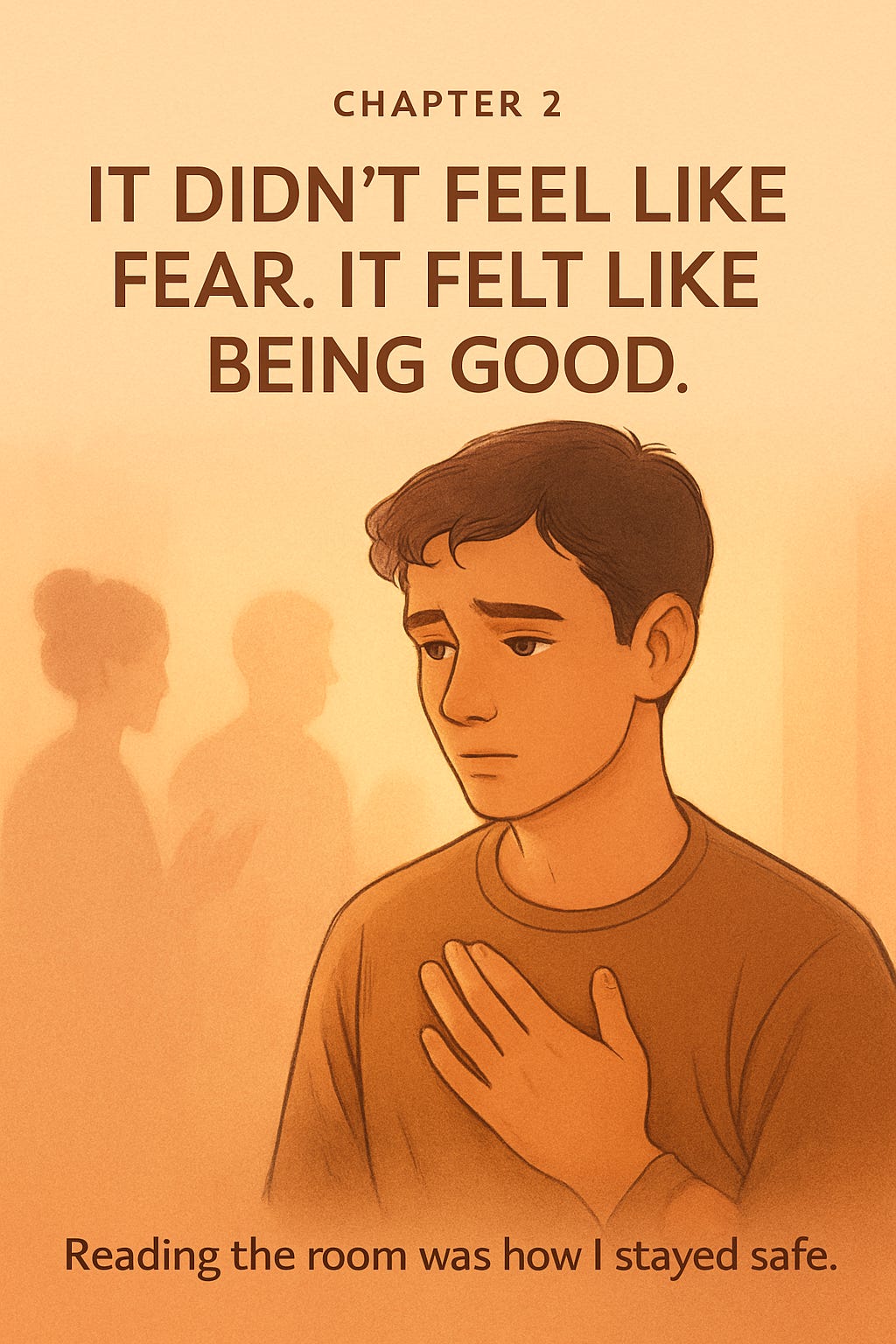
Chapter 2: It Didn’t Feel Like Fear. It Felt Like Being Good.
Reading the room was how I stayed safe.


Hey again,
It’s Michael Mojica. I’m back with Chapter 2 of The People Pleaser’s Way Out, and I just want to say thank you, for reading, for feeling, for being part of something that’s unfolding in real time. Whether this is your first chapter or you’ve been with me from the start, I’m glad you’re here.
If you don’t already know me, my background is in attachment repair and nervous system healing. I’ve spent years working with people who feel like they’re stuck being the “good one”, the reliable one, the one who smooths everything over. What I’ve seen, again and again, is that what looks like people pleasing is often something deeper: a survival strategy built into the body.
This book is about that. It’s not advice. It’s not a fix. It’s a nervous-system-first experience designed to gently unwind the patterns that once kept you safe but now keep you small.
Each chapter is crafted to land, not just in your mind, but in your body. The story lives in your tissues. And every week, I’m writing from both what I know clinically and what I’ve lived personally.
This chapter is called “It Didn’t Feel Like Fear. It Felt Like Being Good.”
It’s about the subtle moments, when reading the room becomes automatic. When attunement isn’t a gift but a duty. When kindness starts to cost you something you didn’t even realize you were giving away.
If you’ve ever adjusted your voice, softened your truth, or read someone’s tone before you read your own body, this one’s for you.
No pressure to understand everything. No need to change anything yet.
Just read. Notice. See what stirs.
And if you want to explore what’s underneath it, the neuroscience, the survival logic, the patterns your nervous system hasn’t had words for, I write a paid companion piece every week that breaks it all down. You’re welcome to join us anytime.
Now let’s step into Chapter 2. I’d love to hear what opens for you.
With care,
Michael
Some people say they’re overthinkers.
I wasn’t thinking at all.
I was listening.
Scanning.
Sensing.
For tension.
For changes in tone.
For the moment someone’s face stiffened, just slightly.
I didn’t know that was fear.
I thought it was empathy.
I thought I was just a good listener.
The kind of person who always knew what someone needed.
Who could step in before things got uncomfortable.
Who could make space for people to feel safe.
And I could.
I did.
But I didn’t realize what I was trading away every time I did it.
My own sense of safety.
It didn’t show up like panic.
It showed up like awareness.
The pause that felt a second too long.
The glance that dropped a little too quickly.
The text that took just a little too long to come back.
The shift in someone’s breath before they said “I’m fine.”
And before I could even think about it,
my body was adjusting.
Soothing.
Shrinking.
Apologizing before anything went wrong.
That’s the thing most people don’t see about people pleasers:
It’s not a decision.
It’s a reflex.
The nervous system picks up the cue,
and before you can name the threat,
you’re already softening your tone,
tightening your smile,
swallowing your truth.
If you grew up in a home where moods turned fast,
where anger hid in silence
or love came with conditions,
your body learned to survive by tracking everything.
And if the safest place in the room was in someone else’s mind,
you went there.
Not out of manipulation.
Not because you didn’t have a self.
But because being close to others’ emotions
felt safer than being inside your own.
Eventually, it became second nature:
You say what they want to hear.
You ask how they’re feeling before you ask what you need.
You stay quiet until you know it’s safe to speak.
You stay smiling until you’re sure they’re okay.
You stay invisible until the tension goes away.
And if they seem fine?
You can finally breathe.
This isn’t weakness.
It’s not co-dependence.
It’s not overthinking.
It’s external regulation.
When no one taught your nervous system how to calm itself,
you learned to borrow other people’s calm instead.
But there’s a cost.
Because when your safety depends on someone else’s mood,
you lose access to your own.
Here’s what it can look like:
Not being able to relax until a conversation is resolved
Worrying you’ve done something wrong when someone’s tone changes
Shifting your opinion mid-sentence just to keep the peace
Feeling responsible for other people’s tension
Forgetting what you were feeling because someone else needed more
You call it sensitivity.
You call it care.
You call it reading the room.
But your body is doing something deeper:
Scanning for danger,
and shapeshifting to stay safe.
And over time, you lose track of which parts of you are real
and which were just survival.
That’s the grief no one tells you about:
That the part of you people liked
wasn’t always the part that was true.
You might still believe this is just how you are,
sensitive, thoughtful, accommodating.
But there’s something underneath that story.
A self you haven’t had to protect yet.
This chapter isn’t here to make you stop scanning.
That would be violence.
We’re not pulling the protection away.
We’re meeting it.
Because when you realize how long you’ve been reading the room
just to keep your place in it…
You start to wonder what it might feel like
to read yourself instead.
You don’t have to know how to stop.
You don’t have to pick a new identity.
You don’t have to un-know how to sense tension.
All you have to do
is notice what your body does
when someone else changes tone.
Don’t judge it.
Just notice.
Where does your breath go?
What muscles tighten?
What part of you wants to leave?
That’s the part we’re here for.
Right now, noticing might still feel like bracing.
But the more you see it, the less power it has.
And soon, you won’t just notice,
you’ll start to relax, even when someone else doesn’t.
You were never too much.
You were never broken.
You were reading the room
because you needed to know where the danger was.
Now, slowly,
you’re going to learn to read yourself.
That’s where safety lives now.
===========
That’s the end of Chapter 2. If something in this chapter landed, you might want to read the companion piece I wrote for paid subscribers blow. It unpacks the nervous system patterns underneath what we explored here, why they form, how they work, and what it means to begin noticing them without judgment.
"The Good One": When Reading the Room Becomes a Way to Stay Safe
Ever catch yourself scanning someone’s tone before they even finish their sentence? Or feeling that micro-shift in a friend’s face and wondering, What did I do? Maybe you’re three steps ahead, already softening your response just in case they’re upset.
Most people would say you’re thoughtful. Attuned. Empathic.
But underneath? Your body is running recon.
It’s not a personality trait, it’s a reflex. And if you’re here, reading this, you probably learned it young.
Behind the Curtain: The Research That Informed Chapter 2
When I sat down to write Chapter 2, It Didn’t Feel Like Fear. It Felt Like Being Good., I didn’t start with a theory. I started with a familiar feeling: the moment someone’s tone shifted, and my stomach tightened before my brain caught up. I’d already adjusted myself before I even knew what I was doing.
That’s what this chapter’s about. Not disappearing entirely like in Chapter 1, but disappearing into someone else. Reading the room so well that you stop reading yourself.
It felt like being good. It felt like being kind. But the truth is, it was survival.
Want to see what’s underneath the rest of this chapter companion?
I wrote a paid companion piece that unpacks the nervous system patterns behind it—what people pleasing really is, why your body chose it, and how we start to shift it.
Read the companion article here!